Problem
Many people with physical disabilities in Eritrea have very limited chances of finding employment on the job market. This often leads to them feeling excluded from society, living very withdrawn lives, and struggling to participate in community life.
Solution
Inspired by the association “Fahrräder für Afrika e.V.”, we launched our first bicycle collection campaign in 2010 for used but still functional bicycles. The enormous response from the public quickly turned this into a long-term project that continues to this day.
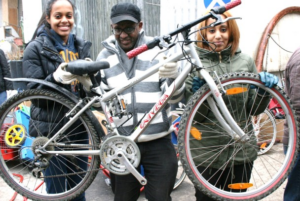
Members of the Eritrean Association for Physically Disabled People in Stuttgart e.V. and many dedicated helpers collect donated bicycles from all over Germany. The bikes are carefully checked, repaired if necessary, and loaded into containers. The containers arrive at the port of Massawa and are then transported to a central warehouse in Asmara.
Our long-term Eritrean partner, the ENWDVA (Eritrean National War-disabled Veterans Association), takes over responsibility on site: they handle storage, customs formalities, and overall organization.
The bicycles are sorted according to condition – intact or easily repairable ones go straight into storage, defective ones are repaired by people with disabilities who have previously received qualified training as bicycle mechanics.
The ENWDVA sets fair prices (usually between 20 and 70 €, depending on condition). The bicycles are then distributed nationwide: each community reports its needs, the bikes are allocated accordingly, and the community pays the amount to the ENWDVA. These revenues create concrete future prospects for war-disabled and other physically disabled people.
Benefits for the Physically Disabled
The bicycle project helps in several areas at once – and that is what makes it so sustainable:
- Training: Many affected people learn the profession of bicycle mechanic from scratch – a real qualification and a real job.
- Income & Self-Employment: Repair and sales processes create earning opportunities. The proceeds flow into microcredits (in cash or in kind), enabling people to start small businesses, open workshops, or build other independent livelihoods.
- Greater Mobility for Everyone: In Eritrea, fuel and car maintenance are extremely expensive – owning a bicycle means real independence for many people for the first time: getting to work, taking children to school, visiting friends and family, participating in village life.
Many who have received a bicycle or helped themselves say:
“Finally, I am no longer dependent on others – I can take my life back into my own hands.”
The project connects donation willingness in Germany with professional, local implementation in Eritrea – genuine help for self-help that has been effective for over 15 years.