Problem
The wars in Eritrea – the 30-year War of Independence (1961–1991) and the border war 1998–2000 – have not only severely strained the country economically, but above all left deep scars on the health and lives of the population.
Over 20,000 people, men and women, young and old, have lived with physical disabilities ever since. In the capital Asmara there is the Denden Centre for Physically Disabled People, which offers space for about 350 severely disabled individuals. However, there is no adequately equipped department for physiotherapy, occupational therapy or psychological support to alleviate physical and emotional suffering.
Many residents feel excluded from social life due to their disabilities. Daily life in the centre is characterized by monotony: some play cards, others turn to alcohol or cigarettes, or simply sit in resignation. There are no offers for psychotherapy, occupational therapy or fitness equipment to promote movement and health. Lack of activity, boredom, hopelessness and sadness shape everyday life. Therapies outside the centre are unaffordable for residents who have almost no money of their own.
Solution
To improve this situation, the idea arose to establish a dedicated physiotherapy and fitness centre within the Denden Centre. Since this was not possible without external funding, the Eritrean Association for Physically Disabled People in Stuttgart e.V. submitted an official project application to the W.P. Schmitz Foundation in Düsseldorf. The foundation approved the application and generously covered 75% of the costs.
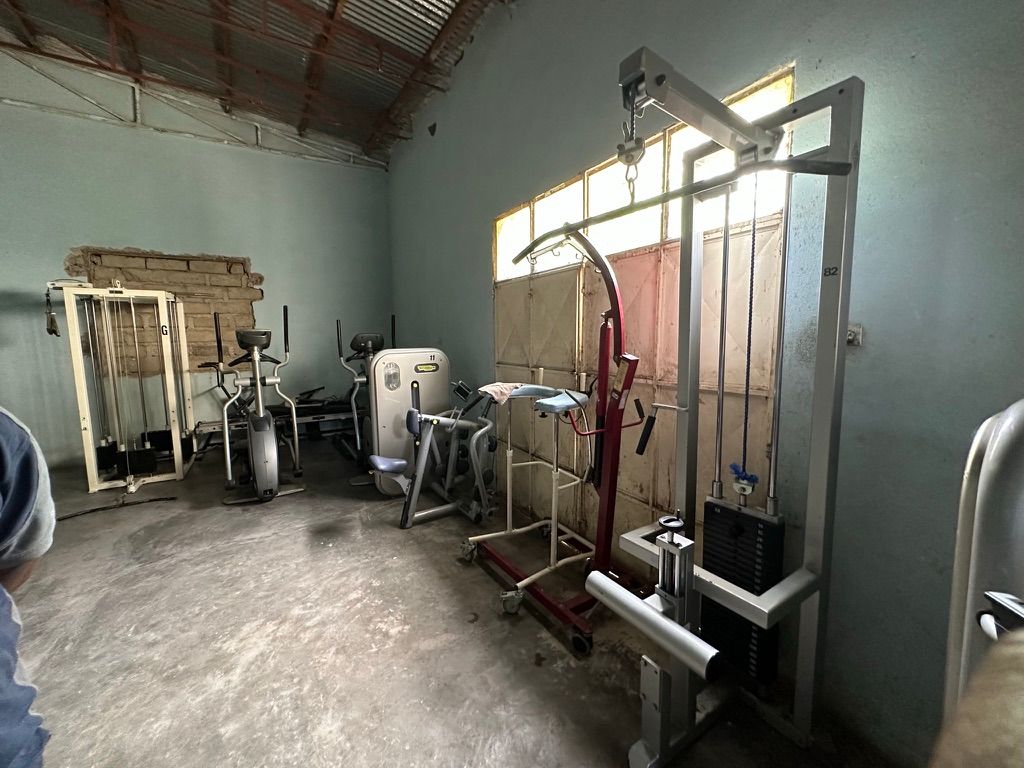
After overcoming the financial hurdle, concrete planning began: together with the local partner association and the affected people, it was determined which equipment was needed. Due to the unreliable power supply in Eritrea, the choice fell on power-independent, used but disability-friendly fitness equipment. Suitable devices were procured via Physiobuy in Steinfurt and shipped by sea to Eritrea.
On site, the Eritrean partner provided a building. Renovation work and structural adaptations (e.g. barrier-free entrance) followed. After successful renovation, the equipment was installed. On 18 April 2018, the fitness and rehabilitation centre was officially opened – in the presence of the then Minister of Health Ms Amna Nurhussein and the Minister of Social Affairs Ms Luul Ghebreab.
Since then, residents can train seven days a week. A trained physiotherapist is on site five days a week in the mornings and afternoons, creates individual training plans, performs manual therapies, and ensures safe, adapted use of the equipment – especially important as many had little prior experience with fitness.
Planned and implemented services include:
- Individual training plan creation
- Manual therapy
- Physiotherapy
- Equipment-supported movement therapy
- General fitness training
- Movement therapy
- Counselling
The centre is located in a former US military barracks, where a small clinic for disabled people is also located (staffed by a doctor, physiotherapist and nurses). The clinic management has taken over administration and care – cooperation has been very positive for years. After one year of operation, the partner organization and our association jointly cover ongoing costs.
Benefits for the Physically Disabled
Through the fitness and rehabilitation centre, those affected receive real opportunities for physical and emotional improvement under professional guidance:
- They regain confidence in their own strength and abilities.
- Targeted muscle training improves mobility and functionality – some can even return to the workforce.
- Physical activity and new positive body experiences bring back initiative, activity and joy of life.
- The bleak clinic routine and post-traumatic war memories fade into the background – distraction and relief emerge.
- Many regain courage and hope that life still holds prospects.
- Working with the equipment distracts from alcohol, nicotine or gambling addiction and helps some to break free.
- Small and larger successes at the equipment provide goals and motivation to take life back into their own hands and become productive again.
The centre is a sustainable contribution to help for self-help – combining financial support from Germany with local implementation and creating tangible improvements in the lives of people in the Denden Centre since 2018.